

Table of Contents
- Everyday Carry Essentials: What Belongs in Your Pockets
- The Core Four: Knife, Wallet, Light, Phone
- Pocket Space and Weight: The Real Constraints
- 1. Pocket Knives: The Foundation of Any EDC Setup
- 3. EDC Tools: Multitools, Pry Bars, and Compact Problem Solvers
- 4. EDC Organizer: Pouches, Key Organizers, and Lanyards
- 5. Budget Tiers: Building Your Carry at $50, $150, and $300
- 6. Legal, Workplace, and Venue Restrictions for Everyday Carry Accessories
- 7. Maintenance, Replacement, and Readiness Checks
- Frequently Asked Questions
Last Updated: October 14, 2026
Everyday Carry Essentials: What Belongs in Your Pockets
Everyday carry accessories are the small, functional items a person keeps on their body every day to handle routine tasks, from opening packages to paying for coffee.
The honest answer is fewer items than most gear lists suggest.
Most people overpack when they start: they buy a pouch, fill it with gear, then leave it at home because it's heavy.
The Core Four: Knife, Wallet, Light, Phone
Four items form the backbone of nearly every everyday carry setup: a knife, a wallet, a light, and a phone.
A pocket knife handles packages, zip ties, and loose threads. A wallet holds your cards and ID.
Everything else in an EDC setup is optional. Build from the core outward instead of starting with a loaded pouch and working backward.
Pocket Space and Weight: The Real Constraints
Pocket space and weight decide whether an EDC setup actually gets carried.
Two front pockets and two back pockets give you a fixed budget.
Weight matters just as much. Small items add up, and a heavy setup pulls at your pants all day.
A useful rule: if you notice the weight, it's too heavy. Trim until you forget it's there.
1. Pocket Knives: The Foundation of Any EDC Setup
A pocket knife is the single most useful everyday carry accessory for most people.
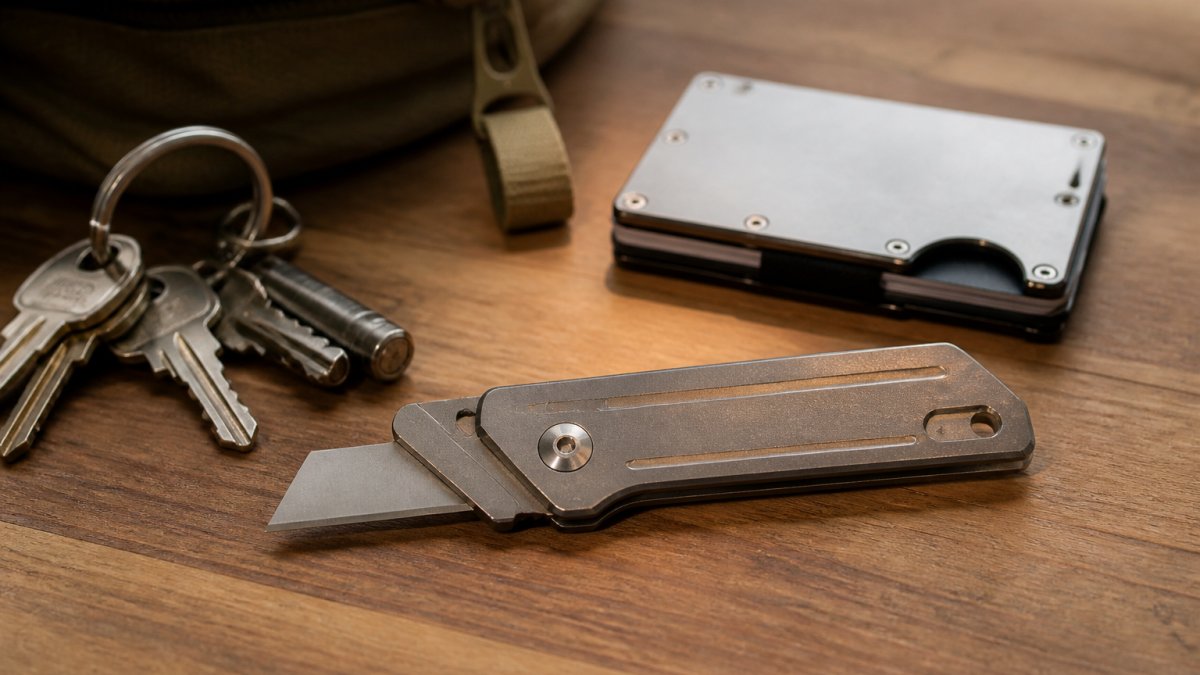
A practical tip: empty your wallet onto a table and count what you touched in the last month. Everything else goes in a drawer.
3. EDC Tools: Multitools, Pry Bars, and Compact Problem Solvers
EDC tools cover the tasks a knife can't: prying, tightening, holding, and scraping. A small pry bar or multitool earns its place when you find yourself improvising with a key, a coin, or the spine of your knife, and improvising is how tools break and knuckles get cut.
The mistake is buying a heavy multitool "just in case." Most people use two or three functions out of twenty, and a compact tool with the functions you actually use beats a full-size multitool you leave at home.
What each tool type actually does
- Pry bar. A flat, wedge-shaped edge for lifting, scraping, and separating. The common failure mode is using a knife tip or key as a pry bar, which snaps the tip or bends the key. A dedicated pry bar has a thicker cross-section and a heat-treated edge so it flexes instead of snapping.
- Bit driver. A 1/4-inch hex socket that accepts standard driver bits, the single most useful non-cutting function for most people. Eyeglasses, cabinet hinges, and loose chair legs all use common bit sizes, and the 1/4-inch hex is the de facto standard, so bits are cheap and available at any hardware store.
- Multitool with pliers. Pliers, wire cutters, and scissors are the functions people actually reach for. If you use pliers weekly, a dedicated multitool earns its weight. If you use them twice a year, a compact tool wins.
Weight and pocket-space trade-offs
Every tool you add competes for the same front-pocket real estate. A compact pry bar or bit driver adds roughly the footprint of a house key; a full-size multitool adds the footprint of a phone.
The RUK V3's pry bar and 1/4-inch hex cover this ground for many people in a single flat tool, cutting, prying, and light driving without adding a second object to your pocket.

Context matters more than the tool list
- Office and school. A compact bit driver and small pry bar read as tools, not weapons, and rarely raise questions. A full-size multitool with a locking blade may violate workplace policy even where local law allows it.
- Travel. Anything with a blade is a hard stop in carry-on baggage. A bit driver and a small pry bar without a blade are the only tool-type items that reliably clear security screening.
- Home and vehicle. This is where a full-size multitool with pliers earns its keep. Keep it in a glovebox or drawer rather than on your body.
A practical rule: carry the smallest tool that solves the task you actually encounter. If you can't name the last three times you needed pliers, you don't need pliers in your pocket.
4. EDC Organizer: Pouches, Key Organizers, and Lanyards
An EDC organizer keeps small items together so they don't rattle around loose in your pockets. But organizers are the most over-bought category in everyday carry, because they solve a problem most people don't actually have yet. The right question isn't "which organizer?", it's "what's currently loose, and what would fixing it cost me in space?"
The three organizer types, compared honestly
Key organizers. A key organizer stacks keys into a compact unit, usually on a single post or hinge, so they sit flat instead of fanning out.
Pouches. A pouch holds a small tool kit, a light, a bit driver, a pen, a few cards, in one object you can grab and go.
Lanyards. A lanyard keeps a knife or light tethered and easy to find in a bag or pocket.
Pocket-space math before you buy
Before adding any organizer, count what's currently loose. With two or fewer loose items, an organizer usually adds more bulk than it removes. With four or more, keys, a light, a pen, a knife, a card sleeve, a single pouch or key organizer can consolidate them into one object and actually reduce the total footprint.
A common pattern: the people who benefit most from organizers carry a bag every day; the people who benefit least carry only in their pockets.
Context-specific setups
- Commuter. A key organizer plus a slim card sleeve handles the loose items that would otherwise rattle in a bag pocket. Skip the pouch.
- Office worker. A small pouch in a bag keeps a bit driver, a light, and a pen together without putting anything on your body, the setup least likely to raise questions at a workplace with a restrictive policy.
- Parent. A pouch with a light, a small pry bar, and a few adhesive bandages lives in a diaper bag or backpack and gets used more than any pocket-carried tool.
The honest caveat stands: organizers add bulk. A pouch only helps if the items inside would otherwise be loose. If your carry is already tidy, skip it.
5. Budget Tiers: Building Your Carry at $50, $150, and $300
Budget shapes an everyday carry setup more than any gear review admits.
| Tier | What to Prioritize | Example Build | Approx. Cost |
|---|---|---|---|
| Starter | Core four, simple designs | RUK-S, basic card sleeve, small light | ~$50 |
| Mid-range | Better materials, more features | RUK-R or RAW V2, quality light | ~$150 |
| Premium | Titanium, full-featured tools | RUK V3, titanium wallet, organizer | ~$300 |
At the starter tier, function matters more than finish.

At the mid-range tier, you start paying for materials and longevity.
At the premium tier, you're buying a setup you'll keep for years.
Spend where you'll notice it: the knife you use daily, and the wallet you open constantly.
6. Legal, Workplace, and Venue Restrictions for Everyday Carry Accessories
Legal and venue restrictions decide where your everyday carry accessories can actually go, and they vary widely by state, city, and building.
Knife law is the biggest variable. The TSA rules on carrying knives in carry-on baggage are a useful reminder that air travel is a hard stop for most EDC gear.
Workplaces add their own layer. Many corporate offices and schools prohibit knives regardless of local law, and some ban "weapons" broadly enough to cover a utility knife.
The practical move: keep a small, non-locking tool for restricted environments and leave the rest at home or in the car.
7. Maintenance, Replacement, and Readiness Checks
Maintenance separates a carry setup that lasts from one that quietly fails.
For utility knives, the main task is blade changes. A dull blade is the most common reason people stop carrying a knife, and the easiest problem to fix.
For everything else, run a simple monthly check:
- Swap or sharpen any dull blade
- Check that locks and mechanisms move freely
- Wipe down metal bodies and check for loose screws
Replacement parts matter too. Standard utility blades are sold everywhere, a real advantage over proprietary blades. If a tool uses a standard consumable, you'll never be stuck waiting on a specialty order.
Readiness is the last piece. The point of an everyday carry setup is that it's there when you need it, on you, working, and allowed where you're going.
Building an everyday carry setup that actually stays in your pockets takes more discipline than most gear lists admit. At Gil-Tek, we build American-made EDC tools designed to earn that spot: the RUK-S for simple, reliable cutting, the RUK V3 for a full-featured knife with a pry bar and bit driver, and the RAW V2 for a slim wallet that holds only what you carry.
Frequently Asked Questions
What are the top everyday carry accessories I should start with?
Start with four items: a pocket knife, a slim wallet, a light source, and your phone. A utility knife like the RUK-S at $15 handles box opening and cord cutting without the bulk of a full-size folding knife. For your wallet, consider how many cards you actually use daily. The RAW V2 holds up to 6 cards in its slim configuration or 9 in the plus size. Add a compact flashlight or headlamp for low-light tasks, and you have a functional everyday carry setup that covers most situations.
How do I choose everyday carry accessories that work together?
Think about three factors: how you dress, where you go, and what tasks you face daily. If you wear slacks to an office, a slim utility knife and a card sleeve fit better than a bulky folding knife and leather bifold. If you commute by car and spend time outdoors, add a multitool and a headlamp. The goal is a carry setup where each item earns its pocket space. Test one new item at a time for a week before adding another.
How can I keep my EDC setup practical and lightweight?
Weigh your current carry. Most people find they haul 12 ounces or more of gear they rarely touch. Remove anything you have not used in two weeks. Switch to slim alternatives where possible: a card sleeve instead of a bifold wallet, a compact utility knife instead of a full-size folder. The RUK-S and RUK-M are slim enough that you cannot tell they are in your pocket. Keep your phone, keys, wallet, and one cutting tool as your non-negotiable core.
What should I carry in my everyday carry kit for work?
For a corporate or office environment, keep it minimal and non-threatening. A compact utility knife like the RUK-S opens packages without looking tactical. A slim wallet or card sleeve handles your cards and ID. Add a pen and a small key organizer. If your workplace restricts knives, check your employee handbook first. A lanyard bead on your keys adds a functional grip point without drawing attention. The goal is gear that helps you work without raising questions.
Do I need a separate EDC organizer for my gear?
Not always, but an organizer helps if you rotate gear or carry items in a bag. A small pouch keeps your knife, pen, and light together so you can move them between pockets and bags without losing anything. For keys, a key organizer reduces jingle and protects your pockets from wear. If you carry a lanyard, a brass or titanium lanyard bead adds weight so the cord hangs straight and stays accessible. Start without an organizer and add one only if you find yourself misplacing items.
0 comments