

Table of Contents
- Men's Minimalist Wallet: What Actually Matters Before You Buy
- Slim Wallet for Men: How Thin Is Thin Enough
- Front Pocket Wallet for Men: Carry Position and Comfort
- RFID Blocking Wallet for Men: What the Protection Actually Covers
- Minimalist Wallet With Money Clip: Handling Cash in a Card-First Setup
- Materials, Durability, and Long-Term Cost
- Card Capacity, ID Windows, and Quick Access
- Common Mistakes When Buying a Men's Minimalist Wallet
- Frequently Asked Questions
Last Updated: October 6, 2026
Men's Minimalist Wallet: What Actually Matters Before You Buy
A men's minimalist wallet is a slim card-and-cash carrier designed to hold only what you use daily, typically six to nine cards plus a few folded bills, in a package thin enough to sit comfortably in a front pocket.
The market has shifted hard toward slim carries. Marketplace listings and community threads now dominate search results for this category, and the conversation has moved past "leather versus metal" into specifics: verified dimensions, real pocket bulk, and whether RFID claims hold up. Those specifics are where most shoppers get stuck, because the numbers on a product page rarely match the feeling of the thing in your pocket.
Slim Wallet for Men: How Thin Is Thin Enough
A slim wallet for men should measure under 12 millimeters at the spine when loaded with six cards, which is roughly the thickness of two stacked house keys. Anything past 15 millimeters starts printing through your pocket fabric and catching on chair arms when you sit down.
Thickness comes from three places: card count, material gauge, and how the wallet holds cards together. A stack of six standard credit cards is about 4.5 millimeters on its own. Add cash folded twice and you are near 7 millimeters before the wallet body even enters the picture.
Thin Profile, Real Pocket Bulk
Published dimensions measure an empty wallet. Real pocket bulk includes cards, cash, and the bulge the whole stack creates against your thigh. A wallet listed at 8 millimeters can sit at 14 millimeters in practice once it is loaded.
Three things drive that gap:
- Card capacity you actually fill. A six-card wallet stays slim only if you carry six cards. Most people carry eleven.
- Cash folding method. A tri-folded bill adds roughly 2 millimeters; a money clip holding bills flat adds almost none.
- Material stiffness. Rigid metal bodies hold their shape and resist bulging. Soft leather sags and spreads, which reads as thicker in the pocket even at the same measured depth.
Front Pocket Wallet for Men: Carry Position and Comfort
A front pocket wallet for men solves the two problems a back-pocket carry creates: sitting discomfort and the slow wear that a thick fold puts on trouser seams.
The trade-off is space. Front pockets are shallower and share room with keys, a phone, or both. That constraint pushes the design toward cardholder shapes rather than bifolds, and it is the main reason slim wallets exist as a category at all.
Comfort depends on more than size. A wallet with rounded corners and no exposed rivets slides in and out without snagging. A wallet with a squared metal edge will catch on denim every time.
What most guides miss is the phone problem.
RFID Blocking Wallet for Men: What the Protection Actually Covers
An RFID blocking wallet for men uses a conductive layer, usually a thin metal sheet or mesh, to interrupt the radio signal that contactless cards use. It blocks the specific frequency range those cards operate on, which in practice means 13.56 MHz near-field communication.
Here is the honest version: the risk RFID blocking addresses is real but narrow. It stops a reader from pulling card data through your pocket at close range. It does not stop online fraud, card-not-present theft, or a compromised terminal you physically tap.
Some metal wallets get this property for free.
Where RFID Blocking Falls Short
Blocking only covers cards that use wireless communication. A magnetic-stripe card, a card number written on a receipt, or a compromised online merchant sits entirely outside what the shield can do.
Three limits worth knowing before you pay extra:
- Range. Blocking works at the distances a skimmer would realistically operate. It is not a force field.
- Card orientation. A card sitting outside the shielded stack, such as one tucked in an external slot, is not protected.
- Your phone. Mobile wallets broadcast by design. A blocking wallet does nothing for the phone in your other pocket.
Minimalist Wallet With Money Clip: Handling Cash in a Card-First Setup
A minimalist wallet with money clip keeps bills flat against the wallet body instead of folded into a bill compartment, which saves both thickness and the time you spend unfolding cash at a register. For anyone who still uses paper money weekly, this is the feature that decides whether a slim wallet works for you.
Cash handling is where most slim wallets fail. A cardholder with no cash solution forces you to fold bills into a pocket, which defeats the purpose. A clip solves it in a few millimeters.
Clips come in three styles, and they behave differently:
| Clip Style | How It Holds Cash | Best For | Trade-off |
|---|---|---|---|
| Integrated metal clip | Spring tension against the wallet body | Daily cash users who want one object | Adds a few millimeters to the spine |
| External clip | Clamps bills to the outside of the wallet | People who carry cash occasionally | Bills can shift if the clip loosens |
| Elastic strap | Stretches over folded bills | Lightest option, lowest cost | Wears out faster than metal |
If you carry more than five bills at a time, an integrated metal clip holds up better than elastic. If you mostly tap a card and keep one bill for emergencies, an elastic strap is lighter and cheaper.
Materials, Durability, and Long-Term Cost
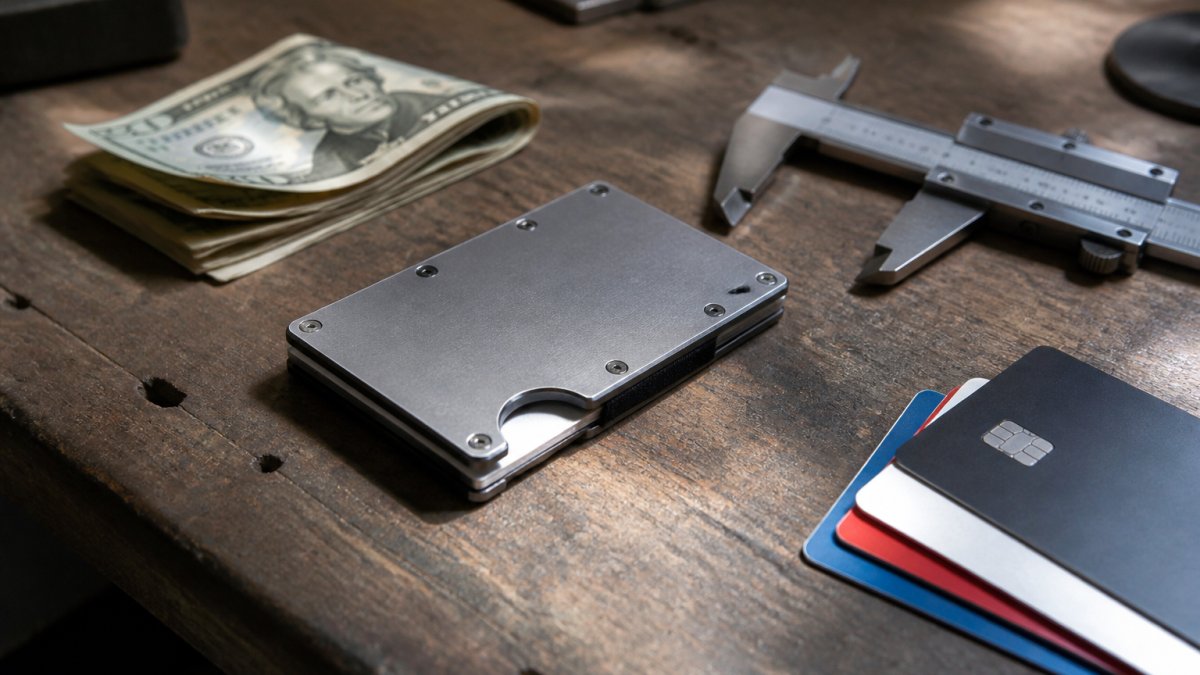
Material choice decides how long a wallet lasts and what it costs you per year of use, not just at checkout. Leather, metal, and carbon fiber each fail in different ways, and the failure mode matters more than the marketing.
Leather, Metal, and Carbon Fiber Compared
Full-grain leather develops a patina and softens with use. It also stretches, which means a leather wallet that fits six cards on day one may feel loose at month eighteen.
RAW V2 (Rapid Access Wallet) →
Metal wallets resist stretching entirely. Anodized aluminum stays light, titanium resists scratching better and weighs less than steel, and stainless steel offers the most rigidity at the highest weight. A metal body will outlast a leather one in structural terms, though the finish can show scuffs.
Carbon fiber sits between the two. It is light and stiff, and it does not corrode, but it costs more and offers fewer repair options than metal.
- Leather: best feel and finish variety, shortest structural lifespan, easiest to break in
- Aluminum: lightest metal option, anodized finishes resist wear, good value
- Titanium: lightest and most scratch-resistant, highest cost
- Stainless steel: most rigid, heaviest, most affordable metal
- Carbon fiber: light and stiff, premium price, limited repairability
Long-term cost is the number most shoppers ignore. A wallet that costs more upfront but lasts several times longer usually wins on cost per year.
Card Capacity, ID Windows, and Quick Access
Card capacity should match your real daily carry, not your maximum. The right number is the count of cards you use in a typical week, plus one for emergencies. For most people, that lands between six and nine.
Overfilling is the single fastest way to ruin a slim wallet.
Quick access matters more than capacity for daily use. A wallet that requires you to fan out every card to find one slows you down at every register.
ID windows are the feature people either need or ignore. If you show identification regularly, at a workplace, a building entrance, or a transit gate, an ID window saves real time.
A short checklist for evaluating any slim wallet before you commit:
- Loaded thickness under 12 millimeters with your real card count
- Rounded corners that will not snag pocket fabric
- Access design that exposes one card, not the whole stack
- Cash solution that matches how often you actually use bills
- Shielded stack if you want RFID protection on your primary cards
- Replaceable or repairable parts, or a warranty that covers structural failure
Common Mistakes When Buying a Men's Minimalist Wallet
The most common mistake is buying for the wallet's ideal capacity instead of your actual carry.
Three more failures show up again and again:
Chasing thinness past usefulness. A wallet so minimal it cannot hold your transit card, ID, and two payment cards is a downgrade, not an upgrade. Set a floor on capacity before you set a ceiling on thickness.
Ignoring how you pay. If you tap a card most of the time but still pull cash weekly, a pure cardholder with no clip will frustrate you within a month.
Trusting the label over the construction. "RFID blocking" and "genuine leather" both describe a range of quality levels.
Skipping the warranty question. Metal wallets can be repaired or replaced by a maker who stands behind the body. Leather wallets usually cannot. Know which you are buying.
At Gil-Tek, we build our RAW wallets in aluminum, titanium, and stainless steel, cut and bent locally, with a slim version rated for six cards and a plus version rated for nine.

Frequently Asked Questions
What should you carry in a minimalist wallet?
Most people need three to six cards: a primary debit or credit card, a backup card, a driver's license, and one or two loyalty or transit cards. Add a small amount of folded cash if you prefer having it on hand. Anything beyond that usually belongs in a bag, not your pocket. If you carry more than six cards daily, choose a plus-size frame rather than forcing a slim model past its capacity, which stretches leather and loosens metal tension over time.
How many cards should a minimalist wallet hold?
Match capacity to your actual daily load, not your maximum possible load. A slim frame typically holds up to six cards, which covers most people's everyday carry. If you regularly carry store cards, insurance cards, or a second ID, a plus-size frame holding up to nine cards keeps the profile thinner than stacking two wallets. Count what you used in the last week, then buy for that number plus one spare slot.
Do minimalist wallets protect against RFID skimming?
Only models built with blocking material or a solid metal plate do. Many minimalist wallets are simply cut-down leather or fabric and offer no shielding at all. Metal wallets and frames with a solid metal card on top of the stack block the radio frequency signal that skimming devices rely on. Check the product listing for an explicit RFID blocking claim rather than assuming slim equals secure, and remember that a blocked wallet only protects cards stored inside it.
Are metal wallets comfortable to carry?
Metal wallets add rigidity and a bit of weight, but their thin profile often makes them more comfortable in a front pocket than a thick leather bifold. The trade-off is that a rigid frame does not flex with your leg, so pocket depth matters. A wallet roughly the size of a credit card with a smooth finish slides in and out easily. Look at weight and edge finish in the specs, since sharp or unfinished edges are the main comfort complaint with low-cost metal options.
Your wallet is the one object you touch more than almost anything else you own, and most people replace theirs every year or two because they bought for looks instead of carry style. Gil-Tek builds American-made metal wallets for people who would rather buy once: veteran-owned, family-run, engineered in Colorado, with a slim six-card RAW for light carries and a plus version for nine. Get started with Gil-Tek and carry a wallet that still looks and closes like new after the first year.
0 comments