

Last Updated: October 28, 2026
Quick Summary
To choose everyday carry gear for work, start with your actual tasks rather than a shopping list, tracking your workday for a week to see what you repeatedly need. Build your kit in layers, beginning with a base layer of wallet, phone, keys, and one cutting tool, then add work and contingency layers only as your day demands.
- A practical work core covers four jobs: cutting, light, writing, and quick fixes.
- Build in three layers: base, work, and contingency, adding capacity as needed.
- Check your employee handbook, manager, and building rules before carrying any tool.
- Score each item on task frequency, carry location, weight and bulk, and rules and durability.
- The RUK-S uses standard utility blades and locks in both extended and retracted positions.
Table of Contents
- Start With Your Actual Workday, Not a Gear List
- Work EDC Essentials: The Core Items Worth Carrying
- How to Build an EDC Kit in Layers
- EDC Gear for the Office: Keep It Clean and Low-Profile
- Pocket-Friendly EDC Items That Disappear in Your Pants
- Match Gear to Your Role and Workplace Rules
- A Decision Framework for Choosing Each Piece
- Build Your Work Carry Around a RUK Utility Knife
- Frequently Asked Questions
Start With Your Actual Workday, Not a Gear List
Most people build their everyday carry gear backwards. They buy gear they like, then hunt for reasons to carry it. The better approach starts with a plain question: what do you actually do between leaving home and getting back?
If you want to know how to choose everyday carry gear for work, the answer begins with your tasks, not a shopping list. The gear that earns its pocket space is the gear that solves a task you repeat.
Track your workday for a week. Note every moment you needed to cut something, open a package, tighten a screw, sign a form, or find something in the dark. That list is your real kit.
Work EDC Essentials: The Core Items Worth Carrying
Work EDC essentials are the small set of tools you reach for during a normal shift. A practical core covers four jobs: cutting, light, writing, and quick fixes.
Here is the short version of what most workdays call for:
- A cutting tool for boxes, tape, and packaging
- A light for dim spaces and dropped items
- A pen and small notebook for notes and signatures
- A small fix-it tool with a driver bit or two
- A wallet and phone you can reach without digging
That is a complete kit. Everything past it is optional. The Consumer Product Safety Commission guidance on safe tool use is a useful reminder that sharp tools belong in a secure, predictable carry position.
Cutting Tools: Pocket Knife or Utility Knife
For a work kit, consider whether a utility knife or a pocket knife better suits your tasks. Utility blades are replaceable.
A folding pocket knife has its place. A compact utility knife can be used for opening boxes, cutting tape, and trimming material. If you want to see the swap process before you commit, this guide on how to change a utility blade in a compact EDC knife walks through it.
Lighting, Writing, and Small Fix-It Tools
A small flashlight is one option to consider.
For writing, a pen and a pocket notebook can be used for notes, lists, and signatures. For fixes, a bit driver with a couple of common bits can be used on loose screws.
How to Build an EDC Kit in Layers
Building an EDC kit in layers means starting with what stays on your body, then adding only what your day demands. Each layer adds capacity.
Think of three layers:
- Base layer carried every day, no exceptions
- Work layer added for the shift or the task
- Contingency layer for odd jobs and emergencies
The base layer is your wallet, phone, keys, and one cutting tool. The work layer might be a light and a notebook. The contingency layer could be a small pouch with a driver, tape, and a spare blade.
Pocket Carry, Pouch Carry, and Bag Carry
Pocket carry keeps items on your body. Pouch carry moves small tools into one case. Bag carry puts items in a backpack or work bag.
Each has a trade-off. Pocket carry is limited in space. Pouch carry adds one more thing to grab. Bag carry leaves your gear behind when you set the bag down.
Pick your primary carry method first. Then let the other two support it. For concrete ways to expand a layered setup, these modular everyday carry setup ideas show how the pieces fit together.
EDC Gear for the Office: Keep It Clean and Low-Profile
For office EDC, consider whether a tool's appearance suits your workplace.
Consider how a tool's size and appearance fit your workplace. The same logic applies to your wallet: consider how its size affects how it sits in your pocket.
A few habits to consider for office carry:
- Keep tools in a pocket, not clipped to a belt
- Choose muted finishes over bright colors
- Carry one cutting tool, not three
- Leave the larger kit in your bag
If you want a deeper, office-specific list, this article on minimal EDC gear for the office covers the tools that fit without raising eyebrows.
Pocket-Friendly EDC Items That Disappear in Your Pants
When choosing pocket-friendly EDC items, consider their size, weight, and shape.
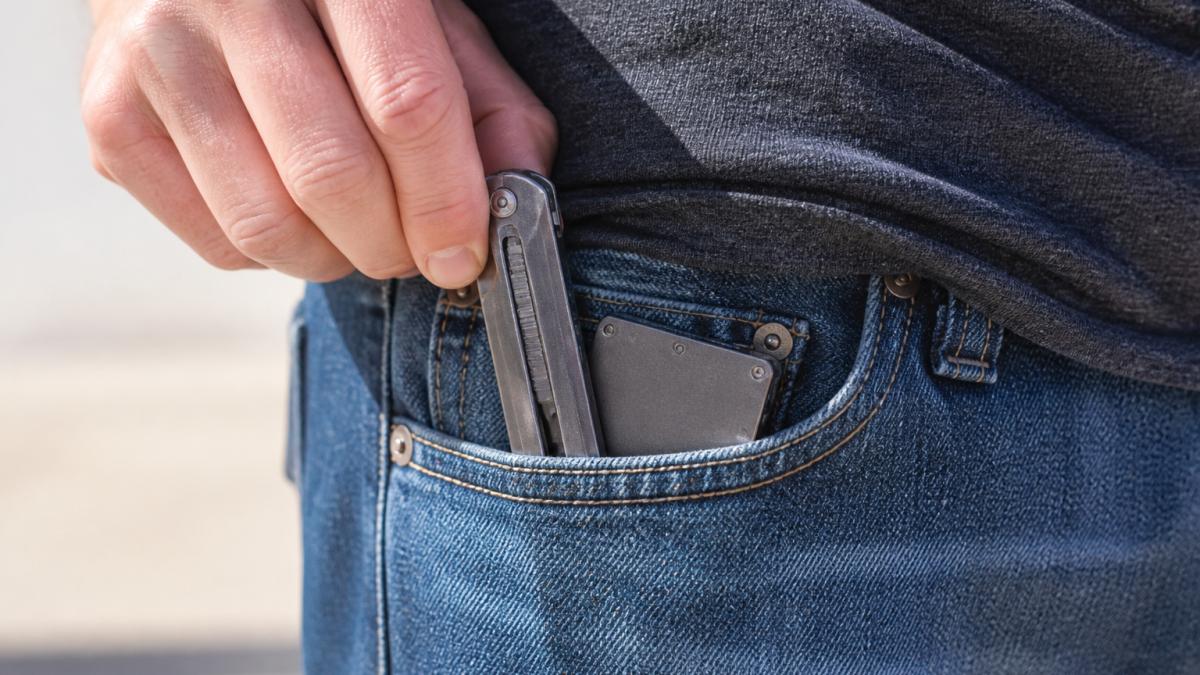
Consider a tool's thickness, length, and weight when deciding how it fits your pocket.
Consider both appearance and fit when choosing a tool. Check the body thickness and the weight.
Match Gear to Your Role and Workplace Rules
Role and workplace rules can inform your kit. A warehouse worker, an office manager, and a field technician may have different tasks and limits. This section maps gear to job-related considerations.
Start with your role, then pressure-test each item against policy and comfort.
Role-Based Starting Points
- Desk-based roles (office, admin, sales): a slim pen, a pocket notebook, a compact utility knife with a short blade, and a keychain light. Keep the profile low and the finish neutral.
- Field and trade roles (technician, installer, maintenance): a heavier-duty cutter, a bit driver with Phillips and flathead bits, a brighter handheld light, and a small pouch to keep it all together. Expect to replace blades more often.
- Healthcare and clean environments: many facilities restrict knives and outside tools entirely. A pen, a small light, and a notebook are usually safe; confirm with infection control or your supervisor before carrying anything with a blade.
- Hybrid and mixed roles: a pouch that moves between desk and site solves the split. Keep the base layer on your body and add the work layer only when the day calls for it.
- Driving and delivery roles: a cutter you can open one-handed, a light for the cab and cargo area, and a pen for signatures. Avoid anything that can roll under the seat or catch on a seatbelt.
How to Check Workplace Rules
Employer policy varies widely, and a tool that breaks policy is a problem, not a convenience. Before you carry, do three things:
- Read the employee handbook for language on weapons, knives, blade length, and personal tools. Many handbooks ban knives outright or cap blade length at a specific measurement.
- Ask your manager or HR in writing if the handbook is silent. A short email creates a record and avoids surprises.
- Check building and site rules if you work in a shared facility, school, hospital, or government building. Security screening and prohibited-items lists often go beyond employer policy.
Workplace rules vary. When in doubt, check the applicable policy before carrying a tool.
Comfort and Clothing Compatibility
Consider comfort and clothing compatibility. Check how a tool sits when you sit, drive, crouch, and reach overhead. If you wear a uniform or business clothing, consider how the tool fits with your clothing.
For a deeper look at how to keep a kit minimal in a professional setting, this article on minimal EDC gear for the office covers the tools that fit without raising eyebrows.
Different roles call for different starting kits, so match your gear to the job before you carry it.
| Role | Suggested gear | Note |
|---|---|---|
| Desk-based roles | Slim pen, pocket notebook, compact utility knife, keychain light | Keep profile low and finish neutral |
| Field and trade roles | Heavier-duty cutter, bit driver, brighter handheld light, small pouch | Expect to replace blades more often |
| Healthcare and clean environments | Pen, small light, notebook | Confirm with infection control before carrying a blade |
| Hybrid and mixed roles | Pouch that moves between desk and site | Keep base layer on body, add work layer as needed |
| Driving and delivery roles | One-handed cutter, light for cab and cargo, pen | Avoid items that roll under the seat or catch on a seatbelt |
A Decision Framework for Choosing Each Piece
A decision framework can help you evaluate items for your kit. Score each candidate item on four dimensions.
The Four Dimensions
- Task frequency: How often did you need this task solved in the last two weeks? Consider that frequency when deciding whether to carry the item.
- Carry location and reach time: Consider how quickly you can reach the item from where you carry it. Match the item to the layer where you expect to reach for it.
- Weight and bulk budget: Consider the weight and bulk of your base layer. Weigh each item and compare it to the space it takes up.
- Rules and durability: Does it meet your workplace rules? Consider the tool's durability and maintenance needs.
How to Score and Decide
Give each item a simple pass or fail on all four dimensions. Use the results to help decide what to carry.
A worked example: consider how a full-size multi-tool, a compact utility knife, or a folding knife fits your tasks, carry location, workplace rules, and clothing.
Budget and Value Over Time
Consider how often you expect to use a tool and whether it can be maintained. Check the product information for blade compatibility, fasteners, and warranty terms.
Test, Maintain, and Prune
Consider whether you reach for an item, whether it suits your preferences, and whether it complies with workplace rules. Check blades and batteries as needed.
For the underlying criteria behind each pick, this guide on what makes a good EDC tool explains the traits worth prioritizing.
Build Your Work Carry Around a RUK Utility Knife
A work carry should center on one tool you trust for the cutting tasks that fill your day. The RUK line includes compact utility knives.
The RUK-S uses standard utility blades, can be controlled with one hand, and locks in both the extended and retracted positions. Its body is CNC machined from 6061-T6 aluminum. It also has a built-in bottle opener and a lanyard slot.

The RUK V3 includes a pry bar for light-duty tasks, a 1/4-inch hex for driver bits, and threaded holes for pocket-clip attachment. It comes in left- and right-handed versions and in aluminum, brass, or titanium. The RUK-M Micro is a small version of the RUK with a blade and a titanium body.
The RUK-S, RUK V3, and RUK-M are made in the USA. Gil-Tek is veteran and family-owned.
Frequently Asked Questions
What should I carry in my everyday work bag?
Consider keeping items such as a small flashlight, a pen and notebook, a charging cable, and bandages in your bag. Your pocket layer can hold items you reach for often, like a utility knife and your wallet. The bag can hold backup and less frequent tools.
How do I choose everyday carry gear for my job?
List the tasks you repeat most during a shift, then consider which tools suit them. If you open boxes, a utility knife may be one option. If you sit at a desk, consider what items suit your work. You can assess each item before adding the next.
What should I consider before carrying a knife at work?
Check your employee handbook and any building security rules first, since policies vary by employer and location. Check your workplace policy before carrying a knife. The RUK-S uses standard utility blades. When in doubt, ask before you carry.
How often should I review my work EDC setup?
Review your setup when your role changes. Consider whether you still use each item and whether it works for your needs.
Your workday already tells you what to carry. The hard part is choosing one cutting tool you will actually keep in your pocket, day after day. Gil-Tek builds the RUK-S, the RUK V3, and the RUK-M Micro as slim, one-handed utility knives with standard blades, aluminum or titanium bodies, and no-disassembly cleaning. Get started with Gil-Tek and build a work carry around a tool that disappears in your pocket until you need it.

0 comments