

Table of Contents
- Why Minimal EDC Gear Matters for Office Workers
- Office EDC Essentials: What to Carry and Why
- Building a Minimalist EDC Setup That Works
- EDC Pocket Tools for Daily Office Tasks
- The Office Pocket Knife: Professional Considerations
- Quick Comparison: Which Tool Fits Your Carry
- Frequently Asked Questions
Last Updated: October 19, 2026
Why Minimal EDC Gear Matters for Office Workers
Carrying too much slows you down. Most office workers stuff their pockets with items they rarely use, creating bulk, weight, and distraction.
Minimal EDC gear for office environments balances preparedness and practicality. You're not running tactical operations, you're opening packages, taking quick notes, and managing cards and cash.
At Gil-Tek, we design tools for this reality with one principle: every item must earn its place.
Office EDC Essentials: What to Carry and Why
Most office professionals benefit from four layers: carry systems, cutting tools, writing tools, and quick-access items. You don't need all of them, just the ones that match your actual workday.
Track what you reach for during a typical day: boxes, tape, paper notes, your phone, cards. Most office workers discover they use fewer items than they thought, and that clarity is where minimalism begins.
The Slim Wallet: Your First Essential
A slim wallet is the foundation of minimal EDC gear for office. The standard bifold creates unnecessary bulk, and you don't need every card you own.
The RAW V2 from Gil-Tek holds up to six cards in the slim version, covering most office scenarios: ID, one or two credit cards, maybe a transit card.

What works: Metal construction won't wear out, and the form factor forces you to carry only what matters.
What doesn't: If you regularly carry more than six cards, you'll outgrow the slim version; the plus-size RAW holds nine but adds thickness.
The Pocket Knife: Practical and Professional
A pocket knife isn't tactical gear for office environments, it's a tool for opening boxes, cutting tape, and handling small tasks. Choose something that looks professional and performs reliably.
Size matters. A full-size folding knife is overkill for office work. A utility knife with a standard blade is more practical than a folder: consistent cutting performance without fumbling with deployment mechanisms.
Building a Minimalist EDC Setup That Works
The real test of minimal EDC gear for office is whether you actually carry it. Comfort comes from weight, pocket fit, and genuine utility, but comfort alone doesn't create a system. What most guides miss is a tiered structure you can adjust to your day, role, and commute.
The Three-Tier System: Pocket, Bag, Desk
A genuinely minimal setup isn't one fixed list. It's three layers you can mix and match.
Tier 1, Pocket baseline (always on you): A slim card holder, one compact cutting tool, and your phone.
Tier 2, Bag add-ons (commute or hybrid days): A small pen, pocket notebook, compact penlight, charging cable, and basic first-aid pouch.
Tier 3, Desk kit (stays at work): A backup charging cable, a small screwdriver or bit set, spare utility blades, and a lint-free cloth.
Role-Specific and Commute-Specific Adjustments
Office workers aren't one group: a desk-based driver has different needs than a hybrid commuter or a field staffer who visits client sites.
- Desk-based worker: Pocket tier plus desk kit. Skip the bag tier entirely. You're never more than 50 feet from your supplies.
- Hybrid commuter (public transit): Pocket tier plus a trimmed bag tier. Prioritize one-handed access because you may be standing or holding a rail. A utility knife with a sliding mechanism you can open with one hand matters more here than blade length.
- Field staff or client-site visitor: Pocket tier plus bag tier plus a small pouch for receipts and business cards. Check client-site security policies before you arrive, since some buildings screen bags.
- Frequent flyer: Pocket tier only, and verify TSA rules for any cutting tool before packing. A utility blade that's replaceable and small is easier to justify than a fixed blade.
How to Decide What Stays
Use a two-week test. Week one, carry your proposed setup and note each time you reach for something. Week two, remove anything you didn't touch.
Weight and pocket comfort determine whether you'll stick with your setup. A heavy knife or thick wallet gets left home.
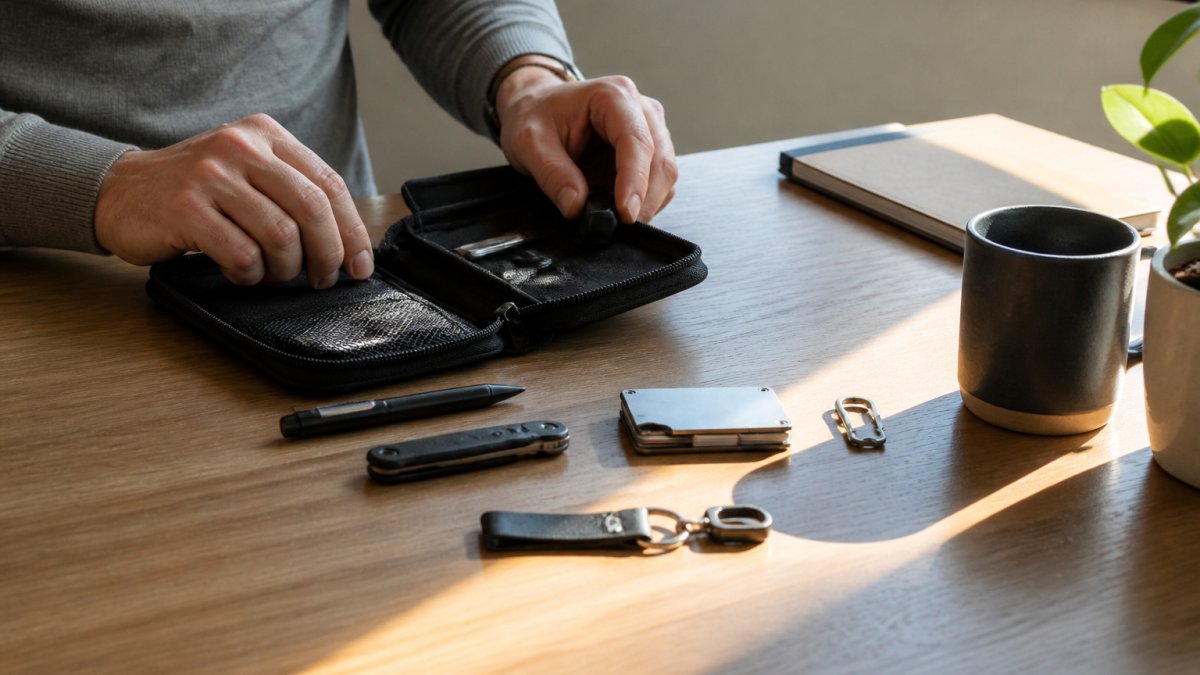
The pocket knife is the second essential because most office tasks require cutting: packages, tags, loose threads.
EDC Pocket Tools for Daily Office Tasks
The pocket knife category includes several approaches. Each has tradeoffs.
RUK-S: The Simple, Reliable Choice
The RUK-S is a utility knife for people who use knives constantly but don't need complexity.

The philosophy is straightforward: most cutting tasks use only a small portion of a full blade, so why carry a full-size knife?
What works: Simplicity means reliability. No complex mechanisms to break. Blade changes take seconds. The aluminum construction is durable for office tasks.
RAW V2 (Rapid Access Wallet) →
What doesn't: If you need a pry bar or other multi-tool features, this isn't it. It's a knife, not a multi-tool.
RUK V3: Versatile Multi-Function Design
The RUK V3 adds features without adding complexity: a light-duty pry bar, a 1/4" hex socket for driver bits, and the same one-handed blade control as the RUK-S.
Threaded holes accept any standard pocket clip.
What works: The pry bar and hex socket expand utility without bloat, and the design stays slim.
What doesn't: The added features come with added cost. If you only need a knife, the RUK-S is simpler and cheaper.
RUK-M: Premium Titanium Compact Option
The RUK-M is the smallest and most premium option, machined from 6AL4V Grade 5 titanium.
Titanium is stronger than aluminum, lighter than steel, and more corrosion-resistant, useful in humid environments.
What works: Titanium construction means this knife will outlast you. The compact size is genuinely pocketable.
What doesn't: Titanium costs more than aluminum, and without secondary features it's purely a cutting tool.
The Office Pocket Knife: Professional Considerations
A pocket knife at work needs to look intentional, not tactical. A small utility knife on your desk looks like a tool; a large folder with aggressive styling looks like something else. Presentation is only half the equation, the other half is policy, screening, and the realities of carrying a blade into a professional setting.
Check Your Employer's Rules Before You Carry
Workplace policies vary widely, and the only reliable source is your own employer. Before you carry any cutting tool, do three things:
- Read your employee handbook or policy manual. Search for "weapons," "prohibited items," "tools," and "security." Many policies ban "weapons" without defining the term.
- Ask your manager or HR. "Is a small utility knife for opening packages acceptable?" gets a clearer answer than guessing. Keep the response in writing if you can.
- Check building security requirements. Leased offices, co-working spaces, and government buildings may have separate rules, some screen bags at entrances or use metal detection.
A compact cutting tool is generally accepted as office equipment, like scissors or a letter opener, in many private offices. But "generally accepted" isn't "allowed." If your workplace has restrictions, follow them, no tool is worth a policy violation.
Security Screening and Travel
If your building has metal detectors or bag screening, a metal utility knife will trigger them. Ask security in advance how they handle small tools, some allow them if declared, others require them in a locker or vehicle. For air travel, check current TSA rules before you pack.
Choose a Blade That Fits the Setting
The blade matters less than the overall presentation. A slim, professional-looking knife is appropriate; an oversized tactical folder is not, however practical. A simple framework:
- Blade length: A standard utility blade is short enough to read as a tool rather than a weapon. Full-size folding knives invite more scrutiny.
- Deployment: A sliding or one-handed mechanism that opens deliberately looks more professional than a spring-assisted or flick-open design.
- Finish: Matte aluminum, titanium, or brass reads as a tool. Camo, blacked-out, or aggressive jimping reads as tactical.
- Visibility: A knife you keep in a pocket and use discreetly draws less attention than one clipped prominently to a belt or bag strap.
The Practical Trade-Off
The most professional knife is the one you use calmly and put away. Opening a package in a meeting with a small utility knife is unremarkable; fidgeting with a large folder creates a problem. Match the tool to the task and setting, and you'll rarely have an issue.
Quick Comparison: Which Tool Fits Your Carry
| Tool | Price | Material | Best For |
|---|---|---|---|
| RAW V2 Wallet | $75 | Aluminum/Titanium/Steel | Card and cash carry |
| RUK-S | $15 | Aluminum | Simple cutting tasks |
| RUK V3 | $125 | Aluminum/Brass/Titanium | Cutting plus light prying |
| RUK-M | $100 | Titanium | Premium minimal cutting |
For most office professionals, the RAW V2 wallet plus the RUK-S knife covers everything. If you need a pry bar or hex socket, choose the RUK V3 instead.

The choice comes down to your actual tasks.
Minimal EDC gear for office work isn't about being prepared for everything. It's about being ready for what actually happens. A slim wallet and a reliable cutting tool handle 95% of daily tasks.
Start there. Gil-Tek's tools are engineered to stay with you because they're light, durable, and designed for real work. Add the RAW V2 wallet and a RUK-S knife to your carry and see what changes.
Frequently Asked Questions
What should I carry every day to the office?
A minimal EDC gear setup for office includes a slim wallet for cards and ID, a compact pocket knife for small tasks like opening packages, and perhaps a pen and small notebook. The key is carrying only what you actually use during your workday. Most office workers find that 3-5 items cover 90% of their daily needs. Focus on quality, durable tools that fit professional environments rather than accumulating gear you rarely touch.
What is the best minimalist EDC setup for work?
The best minimalist EDC setup combines a slim card holder like the RAW V2 ($75), a reliable pocket knife such as the RUK-S ($15), and perhaps a quality pen. This three-item foundation handles most office scenarios without adding bulk to your pockets or bag. A minimalist EDC setup emphasizes choosing tools with multiple purposes and leaving behind anything that doesn't earn its pocket space. Start with these essentials and add only if you identify a genuine gap in your daily carry.
Are pocket knives appropriate to carry at work?
Pocket knives are appropriate in most professional office settings, especially compact, refined designs that don't appear tactical. Check your specific workplace policies first, as some corporate environments or security-sensitive facilities restrict blade carry. A small utility knife like the RUK-S with a professional finish fits naturally into business casual and formal dress codes. The key is selecting an office pocket knife that looks intentional and practical rather than intimidating. Many professionals carry them daily without issue.
How do I keep my everyday carry small and organized?
Keep your EDC small by following the minimalist principle: carry only what solves real problems during your workday. Use slim, space-saving designs like the RAW V2 wallet instead of traditional thick wallets. Choose multi-function tools such as the RUK V3, which combines a blade, bottle opener, pry bar, and hex driver in one compact tool. Organize by frequency of use, keeping your most-used items in your front pocket and backups elsewhere. Review your carry monthly and remove anything unused for two weeks.
What makes a quality EDC pocket tool worth the investment?
Quality EDC pocket tools justify their cost through durability, precision engineering, and long-term reliability. Tools made from materials like Grade 5 titanium or anodized aluminum resist wear and corrosion better than cheaper alternatives. American-made tools often include better quality control and support. A well-designed tool like the RUK series handles daily use without degradation, meaning you replace it less often. The real value comes from consistent performance and the confidence that your gear will work when you need it.
0 comments