

Table of Contents
- The Real Trade-Off: Convenience vs. EDC Gear Durability
- Best Everyday Carry Gear: Understanding Your Actual Daily Needs
- EDC Gear Materials Comparison: Aluminum, Titanium, and Steel
- Utility Knife for Everyday Carry: Finding Your Right Fit
- How to Maintain Titanium Tools and Premium Materials
- Total Cost of Ownership: Why Premium Gear Pays Off
- Which EDC Approach Fits Your Lifestyle
- Frequently Asked Questions
Last Updated: October 11, 2026
The Real Trade-Off: Convenience vs. EDC Gear Durability
Most people buy everyday carry gear based on what looks good or costs the least. But there's a fundamental tension most guides ignore: convenience-focused products solve today's problem cheaply, while durable EDC gear pays dividends over years of use. Understanding this trade-off is essential to building a carry setup that actually works for your life.
The difference between grabbing whatever's on sale and choosing gear built to last isn't just about quality, it's about how much you'll actually use something, how long it survives daily abuse, and whether you're replacing it every few months or carrying the same tool for a decade.
The question isn't which approach is universally "better." It's which one matches your actual daily needs and how you define value.
Best Everyday Carry Gear: Understanding Your Actual Daily Needs
Your EDC setup should solve real problems you face every day. Most people overestimate what they'll use and underestimate what they'll actually carry.
What You Actually Use vs. What You Think You'll Use
Most people overestimate what they'll use. That multi-tool with twelve functions looks appealing until you realize you use the blade 95% of the time. The best everyday carry gear does one or two things exceptionally well. A simple utility knife handles opening boxes, cutting cord, and light prying. Start by tracking what you reach for in a typical week, opening packages, adjusting glasses, cutting tape. Most people find their daily needs are far simpler than imagined, which changes everything about how you approach EDC gear durability and material selection.

Pocket Space and Carry Weight Matter More Than You Think
A bulky setup becomes a burden you leave at home. Weight and bulk directly impact whether you'll keep something in your pocket. Premium materials like titanium and aluminum deliver full functionality in a form factor small enough that you won't resent carrying it. Convenience-focused alternatives often feel heavier and bulkier for the same capability, which means you'll leave them behind on days when pocket space matters.
EDC Gear Materials Comparison: Aluminum, Titanium, and Steel
Material choice determines how your tools age, how they feel in hand, and ultimately whether they're worth carrying long-term. But material selection isn't just about feel, it's about measurable durability under the specific stresses daily carry creates.
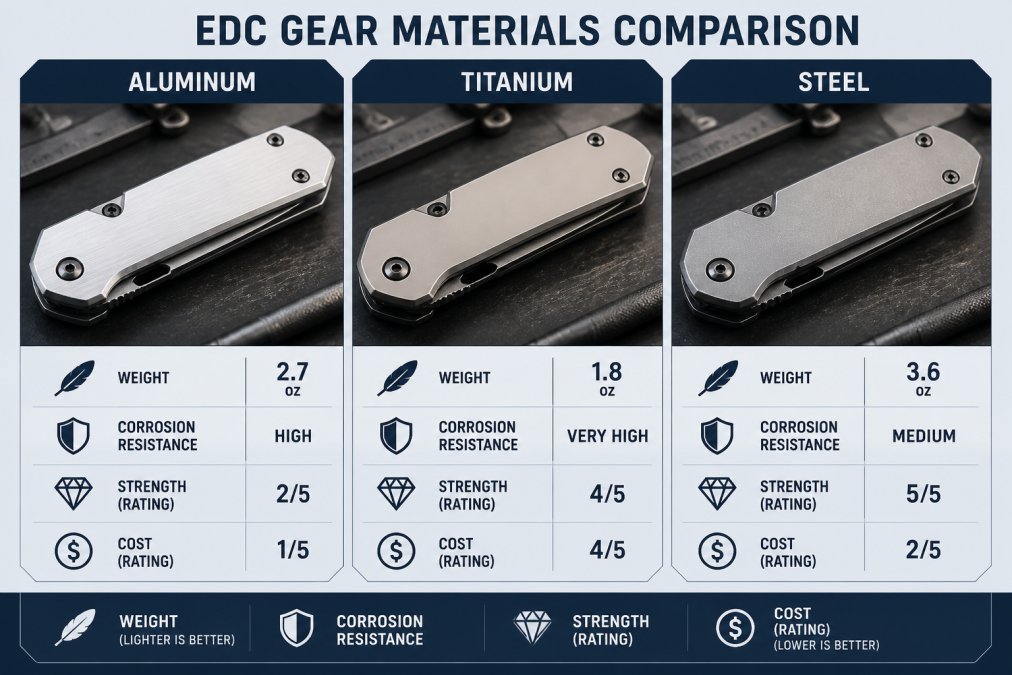
Aluminum (6061-T6 Grade)
Aluminum is lightweight and affordable but dents under repeated pressure. If the anodizing is scratched, the underlying aluminum can oxidize if exposed to moisture. Best for: Casual daily carry and users who don't mind replacing tools every 2-3 years. Aluminum is the convenience-focused choice, affordable upfront, but not designed for indefinite use.
Titanium (6AL4V Grade 5)
Titanium won't corrode, doesn't require maintenance, and handles abuse that would damage aluminum. It doesn't oxidize in any normal environment. Best for: Professional use, outdoor environments, and users who carry the same tool for a decade or longer. Titanium is the durability-focused choice, higher cost reflects superior longevity and zero maintenance.
Stainless Steel
Steel offers maximum hardness and edge retention but requires maintenance to prevent rust. In humid or saltwater environments, it requires occasional wiping to prevent surface corrosion. Best for: Users who need maximum edge performance or work in environments where repairability matters more than weight.
Why Material Choice Affects Long-Term Value
Convenience-focused gear often uses cheaper materials that degrade quickly, adding hidden replacement costs over time. Durable EDC gear uses premium materials because they age gracefully. Titanium won't corrode, dent, or require maintenance. Steel holds an edge longer and can be sharpened indefinitely. When you calculate total cost of ownership over five years, premium materials often cost less than buying cheaper alternatives repeatedly.
Utility Knife for Everyday Carry: Finding Your Right Fit
A utility knife is the foundation of most EDC setups. The right one depends on whether you prioritize simplicity or features.
Simple Design vs. Multi-Feature Options
A simple utility knife does one job exceptionally: extend the blade, cut, retract, lock. The RUK exemplifies this approach. It uses standard utility blades, locks in both extended and retracted positions, includes a bottle opener, and weighs almost nothing. Multi-feature alternatives add pry bars, hex drivers, and specialized tools, but most people never use 80% of what they carry. Simplicity means fewer moving parts and fewer things that can fail, for EDC gear durability, this matters more than feature count.

Blade Control and Safety in Daily Use
One-handed deployment matters for practical use. A utility knife with smooth, reliable blade extension and positive locking prevents accidental deployment or collapse. Cheap options have loose mechanisms that feel unsafe or require two hands to operate reliably. Premium designs lock confidently and deploy smoothly.
How to Maintain Titanium Tools and Premium Materials
Titanium requires virtually no maintenance, which justifies its higher cost. Remove the blade periodically and reinstall it to keep the mechanism clean. For titanium and anodized aluminum, that's all you need, no oil, no special storage, no seasonal maintenance. Premium materials age beautifully and last decades with basic care.
Total Cost of Ownership: Why Premium Gear Pays Off
Blade refills are cheap. Over five years, the cost per year is lower, and the experience is dramatically better.
Replacement Costs and Repair Options
The RUK uses standard utility blades, so refills are always available and cheap. The mechanism can be disassembled for cleaning without special tools.
Warranty and Long-Term Support
A company confident in their EDC gear durability backs it with real support, honoring warranties, answering maintenance questions, and standing behind the product long-term. Cheap alternatives often come with minimal warranty and no real support.
Which EDC Approach Fits Your Lifestyle
Your choice between convenience and durability depends on three measurable factors: frequency of use, consequence of failure, and carry burden.
The Decision Framework: Frequency, Consequence, and Burden
Frequency of use: If you use a tool daily, a premium version saves money over five years. If monthly, the convenience-focused option might suffice. Consequence of failure: If failure creates safety risk, professional liability, or significant disruption, premium durability is essential. Carry burden: A tool you leave at home has zero value, regardless of quality.
| Factor | Convenience-Focused Choice | Premium Durability Choice |
|---|---|---|
| Frequency of use | Monthly or less; occasional tasks | Daily use; core workflow dependency |
| Consequence of failure | Inconvenient; low stakes | Safety-critical; professional impact; time-sensitive |
| Carry burden | Weight/bulk acceptable; doesn't affect daily carry | Minimal weight/bulk; carried every day without resentment |
| Environment | Stable, controlled (office, home) | Harsh, variable (outdoor, salt exposure, temperature extremes) |
| Replacement tolerance | Comfortable replacing every 1-3 years | Prefers carrying same tool for 5+ years |
Use-Case Examples: When Each Approach Makes Sense
Corporate professional: You open packages and cut tape in climate-controlled offices. A simple titanium utility knife works reliably. Choice: Premium durability. The tool lasts a decade; you never worry about it failing. Casual daily user: You use a utility knife twice a week for household tasks. Choice: Convenience-focused or mid-tier aluminum. You save money upfront. Outdoor enthusiast: Your tool faces temperature extremes and moisture. You use it 3-4 times per week. Choice: Premium durability (titanium or steel). The tool survives harsh environments. Tradesperson: You use a utility knife daily, multiple times per day. Reliability is non-negotiable. Choice: Premium titanium or steel. A tool that fails mid-task is unprofessional. Minimalist traveler: Every ounce matters. Choice: Premium titanium. Weight savings and durability ensure the tool survives the journey.

Minimalist Carry vs. Full-Featured Setup
A minimalist setup carries 2-4 items: a simple utility knife, a wallet, maybe a flashlight and a pen. Everything fits easily in pockets. Weight is negligible. You use every item regularly.
A full-featured setup carries more tools and options. It's heavier and bulkier. You use some items daily and others occasionally. It's useful if your work or hobbies genuinely require that functionality.
Neither approach is universally better. The minimalist carry suits corporate environments and people who value simplicity. The full-featured setup makes sense for professionals, hobbyists, and people who face genuinely diverse daily tasks.
Choose based on what you actually do, not what you think you might do someday.
Frequently Asked Questions
What makes an EDC item genuinely useful versus overrated gear?
Useful EDC gear solves problems you actually encounter in your daily routine, not hypothetical scenarios. The best everyday carry gear matches your real tasks: opening boxes, cutting cord, accessing cards. Overrated items look impressive but sit unused. Test your current carry for one week and track what you actually reach for. That data tells you whether premium durable gear justifies its cost or whether simpler, lighter options serve you better.
Is titanium worth the cost for everyday carry tools?
Titanium justifies its cost when you prioritize durability and long-term value. Titanium is one of the lightest materials. If you carry the same tool for 5+ years and value reliability over initial purchase price, titanium EDC gear materials comparison shows it costs less over time than replacing cheaper alternatives. For occasional use, aluminum serves adequately at lower cost.
How do you choose between a simple utility knife and one with multiple features?
Start with your actual daily tasks. If you mainly open boxes and cut cord, a simple utility knife for everyday carry with one-hand blade control and a bottle opener covers 90% of real needs. If you work in environments requiring a pry bar, hex driver access, and cap lifter, multi-feature designs add genuine utility without bulk. The key is avoiding features you'll never use, which add weight and complexity without benefit.
What's the proper way to maintain titanium tools?
Titanium requires minimal maintenance compared to steel. How to maintain titanium tools involves simple steps: remove the blade after use and reinstall it to prevent debris buildup, wipe surfaces with a dry cloth to prevent salt or moisture accumulation, and store in a dry environment. Aggressive cleaning or special products are unnecessary.
0 comments